Read this article in 中文 Français Deutsch Italiano Português Español
INEOS opens commercial CO₂ storage operation in Denmark

September 18, 2026
Greensand launches with capacity for 400,000 tonnes annually and potential expansion to 4 million to 8 million tonnes
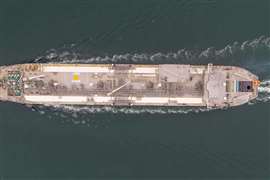
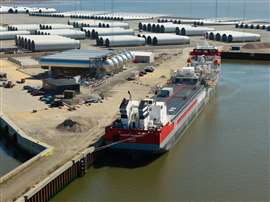 The Greensand CO₂ storage facility, led by INEOS Energy with partners Harbour Energy and the Danish North Sea Fund (Nordsøfonden), is now open. (Image: INEOS)
INEOS Energy and its partners have started commercial operations at the Greensand CO₂ storage project in Denmark, establishing a new European carbon capture and storage value chain that could eventually store as much as 8 million tonnes of CO₂ annually.
The project, developed by INEOS Energy with Harbour Energy and the Danish North Sea Fund, or Nordsøfonden, was officially opened Sept. 18 by Denmark’s King Frederik X at the Port of Esbjerg.
INEOS describes Greensand as the first full-scale CO₂ storage facility operating in the European Union. Its initial commercial phase has capacity to permanently store up to 400,000 tonnes of CO₂ annually, with the project designed to expand to between 4 million and 8 million tonnes annually as demand develops.
“For years, CCS in Europe has been defined by plans, targets and ambitions,” INEOS Energy CEO David Bucknall said. “Today, Greensand brings the EU’s first full-scale CO₂ storage site and value chain into operation.”
CO₂ shipped to offshore reservoir
Initially, INEOS will source CO₂ primarily from Danish biomethane plants, providing volumes that can support commercial operation while larger industrial capture projects are developed.
After capture, the CO₂ will be liquefied and transported by truck to a dedicated terminal at the Port of Esbjerg. From there, it will be loaded onto the Carbon Destroyer 1, a purpose-built CO₂ carrier, for transportation offshore.
The CO₂ will be injected into the Nini West reservoir, a depleted oil field approximately 250 km offshore and about 1,800 meters beneath the seabed.
Greensand is intended eventually to accept captured CO₂ from industrial facilities elsewhere in Europe, creating a cross-border transportation and storage network.
“Greensand starts with biogenic CO₂, but its significance reaches far beyond that first step,” said Mads Gade, CEO of INEOS Energy Europe. “We are ready to expand capacity to receive CO₂ from industries across Europe.”
The project represents the transition of Greensand from demonstration to commercial operation. In 2023, the project completed a pilot in which captured CO₂ was transported from Belgium and injected into the Nini West reservoir.
European storage market developing
The project begins commercial operations as the European Union seeks a major expansion of CO₂ capture, transportation and storage infrastructure.
The EU has established a target of at least 50 million tonnes of annual CO₂ injection capacity by 2030. European Commission estimates indicate approximately 280 million tonnes of CO₂ may need to be captured annually by 2040, increasing to roughly 450 million tonnes by 2050.
That growth would require substantial investment in CO₂ transportation infrastructure. The European Commission estimates that the network could extend as much as 7,300 km by 2030, requiring investment of up to €12.2 billion, and reach approximately 19,000 km by 2040.
The Federation of German Industries and Danish Industry, in a joint position paper issued in conjunction with the Greensand opening, called for development of an integrated European CO₂ market connecting emitters with transportation and storage providers across national borders.
For the compression sector, development of that market would create equipment requirements across the CCS chain as captured CO₂ must be conditioned and compressed for transportation and injection. The Greensand announcement, however, did not identify the compression equipment or suppliers being used in the project’s commercial phase.
CONNECT WITH THE TEAM