Read this article in 中文 Français Deutsch Italiano Português Español
Greene Tweed touts benchmark in hydrogen compression with high-speed composite impeller

December 11, 2025
Company: Record 688 m/s tip speed could reduce compressor size, cost and complexity for emerging hydrogen pipeline networks
Greene Tweed has developed a composite closed impeller capable of reaching a record-breaking tip speed of 688 meters per second—nearly double the operational limits of conventional metallic impellers—marking a major advancement in hydrogen compression technology.
The company said the breakthrough demonstrates how engineered composite materials can improve efficiency, durability and cost competitiveness as hydrogen pipeline networks expand. Europe alone is targeting tens of thousands of kilometers of hydrogen pipelines by 2040, a buildout that will require higher-performing centrifugal compressors to move low-density gases at scale.
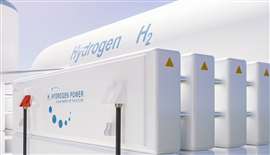 Greene Tweed said newly engineered composite closed impeller set a record-breaking tip speed of 688 m/s in testing – nearly double that of traditional metallic impellers. (Image: Greene Tweed)
Transporting hydrogen through pipelines demands high-speed compression. Traditional metallic impellers typically reach burst limits near 360 m/s for closed designs and approximately 500 m/s for open designs, constraining the achievable compression ratio and often requiring additional compressor stages. More stages translate to larger equipment footprints, higher capital costs and increased maintenance.
Greene Tweed began developing the composite impeller in 2020 using carbon fiber–reinforced PEEK (C/PEEK), aiming to surpass 600 m/s to better handle light gases. After three development and testing cycles, the prototype exceeded expectations.
“Our goal was to create a design that could exceed 600 m/s tip speed for compressing light gases like hydrogen,” said Samuel Stutz, technology manager at Greene Tweed. “The impeller achieved a tip speed of 688 m/s, far exceeding the project’s original target and setting a new industry benchmark.”
The composite impeller is up to five times lighter than metal while offering triple the strength-to-weight ratio. In addition to safety and durability gains, lighter and faster impellers can improve compression efficiency—a meaningful advantage for operators pursuing cost-effective hydrogen transport, storage and utilization.
“We aim to revolutionize hydrogen infrastructure by breaking past the limitations of metals,” said Magen Buterbaugh, Greene Tweed president and CEO. “By delivering solutions that cut costs, simplify operations and drive scalability, Greene Tweed is setting a new standard for the industry. We are now collaborating with centrifugal compressor OEMs to bring this technology to real-world applications.”
As global demand for hydrogen accelerates, equipment manufacturers and pipeline developers are seeking technologies that can reduce lifecycle costs while enabling higher throughput. Greene Tweed said its composite impeller positions the company to play a central role in next-generation hydrogen compression systems.
Greene Tweed manufactures high-performance thermoplastics, composites, seals and engineered components for industries including energy, aerospace, defense, semiconductor, chemical and pharmaceutical processing.

CONNECT WITH THE TEAM