Europe, Gulf region hydrogen pipeline studied

June 27, 2023
Study underway of how the Gulf region and Europe could be linked directly with a pipeline to transport low-carbon hydrogen
The concept of a hydrogen pipeline connecting Qatar, Saudi Arabia, Egypt, and traversing the Mediterranean Sea to Europe may seem ambitious, but initial assessment indicates its feasibility.
That’s according to RINA, the inspection, certification and consulting engineering multinational, and AFRY, a European leader in engineering, design, and advisory services. The companies have undertaken an initial study of how the Gulf region and Europe could be linked directly with a pipeline to transport low-carbon hydrogen, a key component in climate-friendly energy and industry systems of the future. The results indicate a transformative opportunity to fully unlock the Gulf’s immense potential as a cost-effective source of low-carbon hydrogen for Europe.
With abundant renewable energy sources (RES) and natural gas reserves, the Gulf region is set to become a leading global producer of green and blue hydrogen, ammonia and other synthesis products, the companies said.
Early analysis shows that a suitable pipeline configuration could transport 100 TWh or approximately 2.5 million tonnes of hydrogen annually, the companies said. Moreover, by constructing additional pipelines of the same nature, the transport capacity could be significantly scaled up.
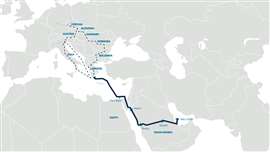 A joint AFRY and RINA study points to feasibility and attractiveness of a Gulf-to-Europe hydrogen pipeline.
The cost of transporting hydrogen through this pipeline is initially seen at approximately 1.2 EUR/kg H2. The Gulf countries, in turn, could supply green and blue hydrogen to the economic hub of Europe at Levelized Costs Of Delivered Hydrogen (LCODH) of around 2.7 EUR/kg starting from the 2030s, decreasing to around 2.3 EUR/kg in the longer term.
Recent geopolitical challenges have forced Europe to explore alternative avenues for energy security, including linking the Eastern Mediterranean and Europe by pipeline, which was investigated for the EastMed Natural Gas project. At the same time, the discussion around exporting hydrogen and its synthesis products from the Gulf to Europe is currently revolving around molecule transport by ship. These options receive EU subsidies and drive activity within the gas/hydrogen industry, but they may not be most efficient for bulk transport. A competitive and actionable pipeline project from the Gulf region in the near future could provide a viable and powerful complement.
“The collaboration between RINA and AFRY provides a unique and highly interesting view of a significant opportunity to take a step forward in the green energy transition for Europe and the MENA region,” said Antonio Nodari, member of the Executive Management Team at AFRY Management Consulting. “As well as understanding the opportunities, the expert team who have worked on this report have a realistic view of the obstacles that need to be overcome and have the solutions to address those challenges.”
MAGAZINE
NEWSLETTER


CONNECT WITH THE TEAM