Read this article in 中文 Français Deutsch Italiano Português Español
Cornerstones Corollary: Evolution of Pipelines and Compressor Stations
February 23, 2026
The Cornerstones of Compression series has highlighted many significant products over more than 160 years of continuous progress. This is the final of seven Cornerstones of Compression corollary articles that provide a look at the evolution of natural gas pipelines and compressor stations.
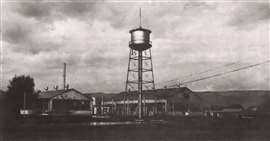 Gala compressor station, c.1960.
The history of the Gala Compressor Station provides another glimpse into how the U.S. gas pipeline network evolved. Located in a valley between two mountains on the western edge of the Shenandoah Valley of Virginia, Gala Compressor Station was a vital pumping unit on a 20 in. (508 mm) diameter gas pipeline that delivered gas from production fields in eastern Kentucky and southern West Virginia. This pipeline was built in the Great Depression days of 1930-31, stretching from Kentucky, across the southern tip of West Virginia, climbing the Alleghany Mountains, crossing the Shenandoah Valley and going on to the Maryland-Pennsylvania border. By the early 1960s, it was owned and operated by Atlantic Seaboard Corporation, part of the United Fuel Gas Corporation and later the Columbia Gas System.
When the pipeline started delivering gas, Boldman Compressor Station at the line’s western end provided all the compression horsepower. As customers’ demands for gas increased, however, it became necessary to provide additional horsepower by the addition of more stations. Gala Station was built in 1940 with the installation of two 900 hp (671 kW) Worthington twin-tandem horizontal gas engine-compressors. In 1942, a 425 hp (317 kW) Worthington single-tandem engine-compressor was added and in 1943, an 800 hp (597 kW) Clark RA-8 right angle engine-compressor was installed. Another Clark RA-8 was installed in 1948.
During the cold days of winter when the need for natural gas was high, Gala had a work force of 14 men to maintain 24-hour operation. This included eight oilers, four operators, a utility man and the station’s supervisory engineer. The oilers made sure that the engines and compressors had the proper lubrication, and they checked on pumps, piping and water jacket temperatures. Operators maintained the engines and reported suction and discharge pressures to the gas dispatcher.
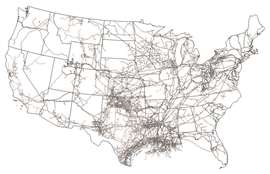 U.S. pipeline network, 2008.
In summer, when the demand for gas was down (before air conditioning was widely used), the engines were idled. During this period, employees overhauled the engines as required. This was typically done after operating from 12,000 to 18,000 hours.
In addition to the engines, Gala had a variety of auxiliary equipment. The cooling system of the very remote station was especially interesting. It included three shell and tube heat exchangers for gas cooling. Water, pumped from nearby Mill Creek, was circulated through these heat exchangers to remove excess heat from the gas and also circulated through the engine jackets to maintain suitable engine operating temperatures. The water was first pumped to a settling pond, from which it flowed by gravity to a storage pond. From there it was withdrawn by pumps and circulated through the heat exchanger and engine jackets, finally returning to the storage pond. Shown in Fig. 1, towering over the station and connected to the high-pressure cooling water header, was a 20,000 gal. (75,708 l) tank which took care of surges in the high-pressure water systems. Also at the station were four gas cleaners or “scrubbers”, which removed sand and other foreign particles by passing the gas through an oil mist.
Beginning in the 1930s, “high-speed” angle integral engine-compressors, such as the Clark RA models, were introduced. These developed more power with less weight and bulk, however installation in remote areas remained very challenging. The angle integrals gradually replaced the horizontals and dominated the industry for half a century. Although many hundred integrals remain in use today, gas turbine-driven centrifugal compressors are the most common gas pipeline machines today.
Cross-Country Gas Pipelines
In 1943, the Chicago Corporation acquired the three-year-old Tennessee Gas and Transmission Company and used it build the first long-haul natural gas pipeline to transport gas from the Texas gulf coast to the northeast part of the U.S. The 1265 mi. (2024 km) pipeline was completed in October 1944 and helped fuel factories making defense materials in the eastern U.S. The U.S. government regulated the rates that the company could charge, so the Chicago Corporation divested itself of Tennessee Gas after World War II. However, Tennessee Gas continued to add pipelines to its network, planning 3840 mi. (6293 km) of additional lines in 1946. With the industrial expansion after World War II, by 1950, two other companies, Texas Eastern Gas Transmission and Transcontinental Pipeline Company had also built gas pipelines from Texas to the northeast U.S. as shown in Fig. 2.
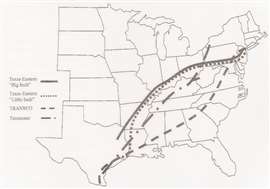 U.S transcontinental pipelines, 1950.
About half of the mainline natural gas transmission network and a large portion of the local distribution network were installed in the 1950s and 1960s because consumer demand for natural gas more than doubled following World War II. The distribution network continued to expand to provide natural gas service to new commercial facilities and housing developments. Natural gas prices increased substantially between 2003 and 2008, giving producers an incentive to expand development of existing fields and to begin exploration of previously undeveloped natural gas fields. Advances in drilling and production techniques led to increases in production from shale and other tight geologic formations. These increases in production contributed to general declines in natural gas prices, which in turn contributed to increases in demand for natural gas for electricity generation and industrial uses. Consequently, more new transmission pipelines were constructed and others were built to link the expanded and new production sources to more consumers around the country, most notably in the Northeast U.S.
By 2008, the U.S. Energy Information Administration (EIA) reported 305,000 mi. (482,820 km) of interstate and intrastate transmission pipelines in the U.S. as shown in Fig. 3.
In 2021, the EIA reported about three million miles of mainline and other pipelines that link natural gas production areas and storage facilities with consumers. The extensive U.S. interstate pipeline network, alone, had more than 1400 natural gas compressor stations and 400 underground storage facilities, more than 11,000 delivery points, 5000 receipt points and 1400 interconnection points by 2021, with countless more facilities dedicated to gas gathering, processing and local distribution. Fig. 4 shows the location of most of the mainline compressor stations that are at the heart of the extensive gas transmission network in the U.S. Arguably, this network generated the need for more large industrial compressors than any other industry.
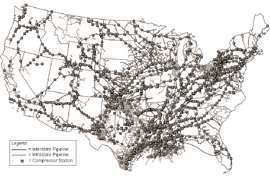 U.S. mainline gas transmission stations, c.2021.

CONNECT WITH THE TEAM