Read this article in 中文 Français Deutsch Italiano Português Español
Boom Supersonic adapts turbine technology for power generation as AI demand rises

December 10, 2025
Crusoe becomes launch customer for 42 MW natural gas turbine engineered from supersonic engine core
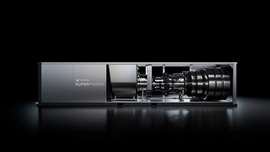 Denver-based Boom Supersonic said it has secured more than $1.25 billion in turbine orders and named AI infrastructure developer Crusoe as the launch customer.
Boom Supersonic, best known for its work to revive commercial supersonic air travel, said it will start selling a version of its turbine engine as a stationary power plant. The Denver-based company said it has secured more than $1.25 billion in turbine orders and named AI infrastructure developer Crusoe as the launch customer.
The announcement came as Boom closed a $300 million funding round led by Darsana Capital Partners, with backing from Altimeter Capital, ARK Invest, Bessemer Venture Partners, Robinhood Ventures and Y Combinator. The turbine program is intended to generate near-term revenue while advancing the company’s long-term aviation goals.
Supersonic-derived turbine targets data center loads
Branded Superpower, the machine is a 42 MW natural gas turbine adapted from the core of Symphony, the propulsion system being developed for Boom’s Overture airliner. While aeroderivative turbines are commonplace in distributed power and industrial applications, Boom is positioning Superpower as a step-change in thermodynamic performance by leveraging engine technologies designed for high-speed, high-heat operation.
The company said the turbine delivers ISO-rated output in a compact, container-scale form factor and maintains its full power rating even in ambient temperatures above 110°F. That contrasts with many conventional turbines, which can lose significant generation capacity during extreme heat events.
Water-free operation is another design priority. Increasingly, data centers are constrained by water availability for cooling and auxiliary systems. By eliminating water requirements, Boom aims to expand deployment options in regions where both heat and water scarcity have slowed new data center development.
“Supersonic technology is an accelerant—of course for faster flight, but now for artificial intelligence as well,” said Blake Scholl, founder and CEO of Boom Supersonic. He said the company is now funded to advance both its turbine program and its airliner.
Crusoe orders 29 turbines for AI growth
Crusoe, a Denver-based AI infrastructure developer that operates power-dense computing facilities, has ordered 29 Superpower turbines. The units will support Crusoe’s growing portfolio of natural gas–fueled data centers, which integrate thermal management, on-site generation and high-performance computing.
“Boom’s innovative approach to power turbine technology builds on the company’s impressive breakthroughs in supersonic flight,” said Crusoe co-founder and CEO Chase Lochmiller. He said the partnership aligns with Crusoe’s energy-first model for building scalable AI infrastructure.
The companies said Superpower’s high-temperature capability, portable footprint and dual-fuel readiness—running primarily on natural gas with diesel backup—make the system suitable for distributed AI workloads that demand rapid deployment and predictable performance.
Production ramp and U.S. manufacturing plans
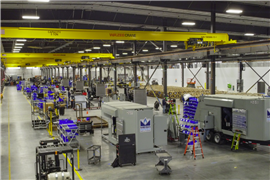
Boom plans to scale turbine manufacturing to more than 4 GW annually by 2030, delivering a portfolio of machines that could collectively supply gigawatts of new data center capacity. All production will take place in the United States as part of the company’s broader reindustrialization strategy.
The company said 95 percent of the components for the Symphony engine core prototype are now in fabrication. Core testing is scheduled to begin in 2026 at Boom’s Colorado test site. Lessons learned from Superpower deployments will feed into Symphony’s certification path, giving the aviation program early real-world operating data.
Darsana Capital said its investment reflects confidence in Boom’s dual-track strategy of commercializing turbine technology while continuing long-term airliner development.
“Boom has assembled an incredible team and executed with impressive discipline,” said Steve Friedman, partner at Darsana. “Their focus on first delivering supersonic technology to create a high-performance power turbine business reflects a smart, capital-efficient path to building the next great American industrial company.”
Aviation ambitions continue
While the turbine program expands Boom’s foothold in the power sector, the company continues to advance Overture, its planned supersonic commercial aircraft. Boom’s order book includes 130 aircraft from carriers such as United Airlines, American Airlines and Japan Airlines. Revenues from the turbine business are expected to support certification and future delivery of the airliner.
Founded in 2014, Boom Supersonic is developing propulsion and airframe technologies intended to enable sustained supersonic flight over water and higher speeds over land using its Boomless Cruise approach.
If you’d like, I can also prepare a shorter web version, add a data-center-side technical box, or create a sidebar comparing Superpower to traditional aeroderivative turbines.

CONNECT WITH THE TEAM