Read this article in 中文 Français Deutsch Italiano Português Español
A “Golden Age” for compression

March 02, 2026
USA Compression’s CEO discusses gas demand growth, large-horsepower strategy, supply chain pressures and workforce challenges
 Clint Green
 brings a rare combination of hands-on field experience and large-scale project execution to his role as chief executive officer of USA Compression Partners, one of the largest contract compression service providers in North America. A former compressor mechanic who later held senior operational and project leadership roles at companies including Energy Transfer, Green assumed leadership of USA Compression at a time when the natural gas market — and the compression sector that supports it — is entering a period of sustained demand growth.
In this interview with COMPRESSORTech2, Green discusses how rising U.S. natural gas demand, driven by LNG exports, power generation and data center development, is reshaping compression requirements across key basins. He outlines why large-horsepower assets remain central to USA Compression’s strategy, how supply-chain constraints and long equipment lead times are influencing fleet planning, and where electrification fits — and does not fit — in today’s operating environment. Green also addresses workforce challenges, the role of digital tools and AI in improving operational efficiency, and the strategic rationale behind USA Compression’s recent acquisition of J-W Power as the company positions itself for what he describes as a “golden age” for compression.
Q: You’ve spent more than two decades in midstream operations and project execution. How has that background shaped your approach to leading a large contract compression organization?
A: I actually started my career as a compressor mechanic back in 1997. I went to work for Hanover, then later joined CDM, which ultimately became part of USA Compression in 2017. From there, I ran projects at Regency and later oversaw operations in West Texas for Energy Transfer for close to five years. After that, I moved into a project execution role out of Dallas.
That hands-on background has been huge for me. I’ve seen this business from the field level all the way up through large project execution. Compression has changed a lot since I first left it — demand is stronger, the market is tighter, and today you can actually make money in the compression business, which wasn’t always the case 15 years ago.
Q: The compression market is seeing strong utilization driven by LNG development, gas takeaway constraints and continued shale activity. What is your outlook for compression demand over the next several years, and how is USA Compression positioning its fleet?
A: We’re extremely excited about gas demand. When you look at LNG pulling several Bcf per day off the Gulf Coast, combined with data center demand that appears very real, it creates localized demand growth in places like the Northeast, where takeaway has historically been constrained.
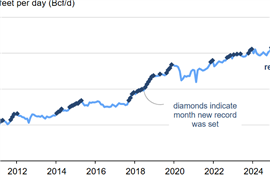
Out West, the Permian is seeing new pipelines announced, some heading west to serve markets like Phoenix and others still moving east. Add to that the conversion of coal-fired power plants to natural gas, and demand continues to rise. A lot of forecasts suggest U.S. gas demand could reach 125 Bcf per day by 2030. We’ve been around 100 Bcf per day for 15 to 20 years, so that kind of growth is very meaningful for compression.
There’s debate about how much compression is required per Bcf — estimates range from 500,000 hp to 1 million hp per Bcf. If you add just 15 Bcf of demand, that’s roughly 7.5 million hp of incremental compression on the low end.
From a positioning standpoint, our recent acquisition of J-W Power is a key piece of that strategy. It expands our footprint into additional basins and strengthens our presence where we already operate. We believe the Permian will capture a significant share of that demand growth, but dry gas basins will also have to contribute. We’re already seeing increased drilling activity in the Northeast, and Haynesville activity could accelerate quickly if gas prices move above $4.50.
Q: USA Compression has historically focused on large-horsepower assets. Do you see continued growth in that segment, and how are customer performance expectations evolving?
A: Large horsepower remains our core focus, and we don’t see any slowdown there. That said, we still operate a meaningful amount of midrange and small horsepower — under 400 hp. Throughout 2025, we made a concerted effort to deploy more of that equipment rather than letting it sit idle. We won’t be ordering new small horsepower unless market conditions change, but if we have it, we want it working.
The demand drivers favor large horsepower. In the Permian, for example, large gas-lift facilities may bring in gas from multiple pads and reinject significant volumes downhole. That takes a lot of horsepower. The same applies to large gathering stations moving 20 MMcf per day or more downstream. Those applications aren’t going away.
Customers also expect high runtime, strong reliability and consistent service support. In a tight market, those expectations only increase.
Q: How tight do you expect the compression market to remain over the next several years?
A: As long as natural gas demand continues to grow at a meaningful pace, compression will stay tight. Equipment availability is already constrained. Engine lead times are stretching out — Caterpillar deliveries are now quoted at up to a 100 weeks in some cases. Ariel lead times are shorter, but without an engine, that doesn’t solve the problem.
We expect strong demand to persist through at least the next four to five years as this next tranche of gas demand comes online.
Q: Supply chain challenges have lingered since the pandemic. What are you seeing today in terms of lead times?
A: Lead times have improved since COVID, but the constraints have shifted. It’s no longer about basic components like gaskets or fasteners. Today, the bottleneck is driven by natural gas engine demand for power generation.
For years, the bulk of natural gas engines went into compression. Now, a much larger share is going into generators, largely due to data centers. Turbine lead times are even more extreme. I recently heard at a conference that if you ordered a turbine today, you might not receive it until 2031. That’s a very long cycle.
Q: Electrification has been a growing topic in the industry. What are you seeing from customers?
A: Interest in electric compression has fallen off since the recent administration change and associated regulatory shifts. There is still some demand, but until the grid can support the level of power required, it’s hard to see electrification growing significantly.
We see situations where cryogenic plants in West Texas have to run on temporary generation for two or three years because utility power isn’t available. In that environment, electrifying large-scale compression is very challenging. We’ll build whatever our customers want, but today the demand is clearly for gas-driven equipment.
Q: Where do you see opportunities to improve efficiency in compression project execution and operations?
A: Like everyone else, we see AI playing a big role going forward. We already collect massive amounts of operating data, and that will only increase. AI will help us operate equipment more efficiently, optimize maintenance and route technicians more effectively.
AI won’t replace field personnel — someone still has to fix the equipment — but it will change how we manage day-to-day operations, which is especially important as it becomes harder to find people willing to work on hot engines in West Texas summers.
Q: How is the labor situation today, particularly for field technicians?
A: We’re fairly well staffed. We always have some turnover, but we’ve been able to find people. We have an extensive training program and regularly bring in people with no prior experience. It takes four to five years to develop a top-level technician, but overall the situation has stabilized compared with a few years ago.
That said, you can’t replace decades of experience overnight. A lot of gray hair is leaving the industry, and that expertise is hard to replace.
Q: Looking ahead, what do you see as the biggest challenges and opportunities for the compression industry over the next five years?
A: The opportunity and the challenge are really the same thing: demand growth. Increasing U.S. gas demand by 15 to 25% creates tremendous opportunity for compression companies, but it also means we have to secure equipment and find people to do the work. It’s a blessing and a challenge at the same time.
Q: What differentiates USA Compression in a crowded market?
A: We take care of our customers. We stand behind our runtime guarantees, we focus on being No. 1 in service every day, and we take safety very seriously. We don’t compromise on safety — for our employees or our customers — and that culture matters.
Q: Is there anything else you want to emphasize for readers?
A: We’re very excited about natural gas demand and the growth opportunities ahead. We’re equally excited about the J-W Power acquisition. That company has more than 65 years of history, and the Westerman family was deeply committed to finding the right partner for their people. We’re honored they chose us, and we see significant upside as we integrate the business and continue to grow revenue, EBITDA and career opportunities for our employees.
CONNECT WITH THE TEAM